THE JOURNAL · SCIENCE · ART OF LIVING
Some of the water gliding over your skin today was already here before the Sun. Born in the cold of an interstellar cloud, it has travelled through more than 4.6 billion years without ever leaving the stage. The story of an element beyond time, and of how Sublio®, through Hyperionisation®, gives birth to an unprecedented water.
By Frédéric Esnault, inventor of Hyperionisation®
THE ORIGIN
More than 4.6 billion years ago, before the Sun had ignited, an immense cloud of gas and dust drifted through our region of the galaxy. Temperatures hovered around -263 °C, barely ten degrees above absolute zero. On the surface of these tiny grains, oxygen and hydrogen slowly bonded until they formed a fine film of ice.
Part of that ice was never lost. The astrochemist Ilsedore Cleeves, of the University of Michigan, showed as much in September 2014, in a study published in the journal Science that made headlines around the world. Her team turned to heavy water, that rare form of water containing deuterium, a hydrogen with twice the usual mass. In our oceans there is one such atom for every 6,420 atoms of hydrogen, a proportion that only the temperatures of deep space can achieve.
The researchers replayed a million years of chemistry around the young Sun on a computer: neither the star nor the disc of matter around it could have produced as much. A fraction of Earth’s water necessarily predates it. By their upper estimates, it would make up 30 to 50 per cent of the water in the oceans, at least 7 per cent by the most cautious, and 60 to 100 per cent of the water in comets. A water “so old that it predates the Earth itself”, as the researcher puts it.
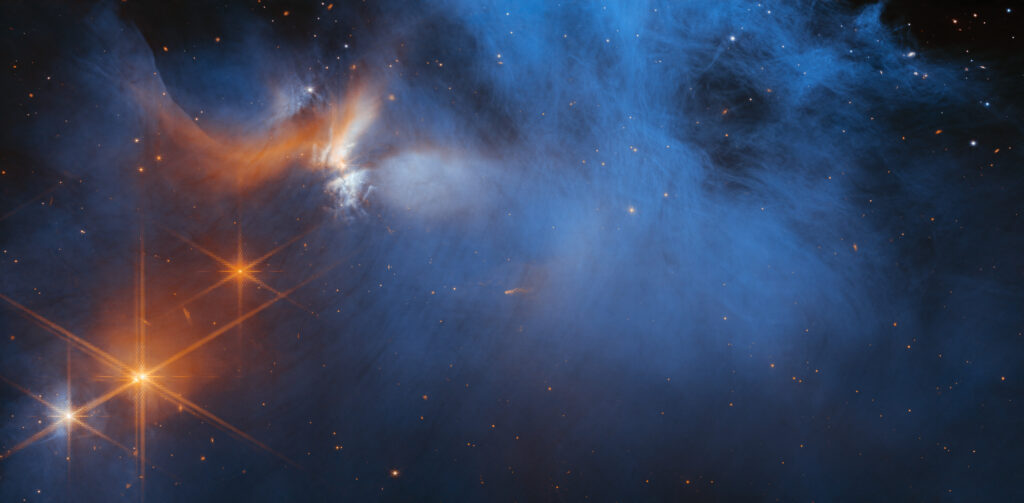
Other frozen cradles like this one can now be observed. In January 2023, the James Webb Space Telescope looked deep into the heart of the Chamaeleon I cloud, some 630 light-years from us. There, its instruments recorded the coldest, most deeply buried ices ever detected in a cloud of its kind, starting with water ice. Very likely a glimpse of our own beginnings.
On Earth, liquid water appeared very early. At Jack Hills, in Western Australia, the geologist Simon Wilde discovered and dated a tiny zircon crystal some 4.4 billion years old. The study, carried out with John Valley and published in Nature in 2001, shows that by then the surface of the globe had already cooled enough, to around 100 °C, to host liquid water. Since our planet formed 4.54 billion years ago, it bore its first waters less than 150 million years after its birth.
Step into a pool, and you are touching matter partly older than daylight itself.
THE CYCLE
The Earth holds some 1.386 billion cubic kilometres of water, more than 96 per cent of it in the oceans, according to the United States Geological Survey. For the most part, it is the same water that has been circulating for billions of years. It evaporates above the sea, travels in the clouds, falls back onto the high ground, streams, seeps into the earth, and one day returns to the ocean.
Each stage has its own tempo. A water molecule spends on average only 7 to 9 days in the atmosphere, a few weeks to a few months in a river, but 3,000 to 3,500 years in the ocean and sometimes up to 10,000 years in underground aquifers, according to estimates gathered by the University of Waikato. The droplet beading on your shoulder may well have slept for centuries beneath a mountain.
Along the way, water dissolves a little of the rock it passes through. It takes on calcium, magnesium, bicarbonates or silica. That is why no two waters are ever quite alike: a spring water from granite, a thermal water risen from the depths, sea water or the water from your city’s mains each carry the mineral signature of the lands they have crossed.
These minerals, water’s silent companions since the very beginning, lie at the heart of the story that follows.
THE SPARK
In August 1993, Frédéric Esnault is staying in Corsica. Above Corte, the Restonica flows down from Lake Melo, which lies at an altitude of 1,711 metres. A torrential river for some ten kilometres, it grows calmer over the next eight, before crossing the town and joining the Tavignano there, at 389 metres. A descent of more than 1,300 metres over some eighteen kilometres: hence its impetuous character. Its water is strikingly fresh and, in places, of an almost unreal clarity.
He bathes in it. On emerging, he notices that something has happened to his skin, a sensation he cannot yet name. On the bank, he falls into conversation with regulars: some have been returning for years, simply to feel well. To hear them speak, this living water brings their skin a certain comfort.
That day, an intuition takes hold that will never leave him: it must be possible to bring forth, from everyday water, a water that does the skin good. It remains to understand how. The minerals in water are among the avenues he senses he must explore, among many others. Only much later will he understand that everything hinges on their ionic organisation.
Thirty-three years of work, including more than sixteen years of dedicated research and development, four million euros invested from his own funds and a rare tenacity: such is what it will take to give form to this conviction. Today it bears a name, Hyperionisation®, and a signature, Sublio®.
The Restonica still flows through Corte, just as it did that summer of 1993. The idea born on its banks, for its part, has come a long way.
THE INVENTION
The paradox is a dizzying one: the minerals that water carries are sometimes as old as the world, while the water born of a Sublio® reactor had never existed before.
The House sums it up in three sentences: Hyperionisation® gives birth to an unprecedented water. Its composition remains unchanged. Its ionic organisation, however, is distinct.
Two inductive plates encircle each reactor and generate waves that act upon the electrical charge of the ions. Nothing is added, nothing is removed, nothing is filtered: the minerality, the pH and the bacteriological quality remain strictly the same. Whether the water comes from the city mains, a spring or the sea, what emerges is a hyperionic water, with an ionic architecture never seen before.
On contact with the skin, its hyperionic minerals, calcium foremost, set the biological mechanisms of the epidermis in motion. Hydration reaches deeper; the skin regains density, firms, and its surface becomes smooth and soft. From the moment you enter the pool, you sense that this water is anything but ordinary; yet it is only once you have stepped out, the skin dry, that you truly measure what has taken place.
This remarkable depth of action is no mere impression. Twelve studies, notably biological and genomic, have been conducted on Sublio technology and have demonstrated its efficacy on the skin. The process is protected by a first patent granted in 2025 (FR3129082), the prelude to a portfolio of patents in constant expansion.
In the houses that welcome it, hyperionic water flows in the pools and the spas, but also in the showers and the bathtubs of the rooms, so that the guest’s skin never loses contact with it. Guests leave. The signature remains.
More than four billion years after the first ice, an unprecedented water has been born. Sublio does not make promises. Sublio demonstrates.
FREQUENTLY ASKED QUESTIONS
Is the water I bathe in older than the Sun?
Yes, in part. According to the study by Ilsedore Cleeves published in Science in 2014, 30 to 50 per cent of the water in the oceans is thought to have formed in the interstellar cloud that preceded the Sun, by the upper estimates. Since all of Earth’s water takes part in the same great cycle, the water in your bath in all likelihood contains a share of it.
Is heavy water different from ordinary water?
Yes, slightly. Its hydrogen gives way to deuterium, a cousin with twice the mass. In its pure form, heavy water is about 11 per cent denser, freezes at 3.8 °C and does not boil until 101.4 °C: an ice cube made of it sinks to the bottom of a glass of water. Nature offers it only sparingly, barely one molecule in 41 million, and our bodies hold the equivalent of five grams, without the slightest danger.
Since when has liquid water existed on Earth?
For at least 4.4 billion years. A zircon crystal discovered in the Jack Hills, in Western Australia, indicates that a surface cool enough to hold liquid water existed less than 150 million years after the planet formed.
Does the composition of the water remain unchanged with Hyperionisation®?
Yes. Nothing is added, removed or filtered: the minerality, the pH and the bacteriological quality remain strictly the same. Only the ionic organisation is distinct, and it is this that makes hyperionic water an unprecedented water.
Does Sublio® work with mains water, spring water and sea water?
Yes. Hyperionisation acts on the electrical charge of the ions the water contains. Each water retains its own minerality, whether it comes from the mains, a spring or the sea, and what emerges is a hyperionic water.
Has the efficacy of hyperionic water on the skin been demonstrated?
Yes. Twelve studies, notably biological and genomic, have been conducted on Sublio technology and have demonstrated its efficacy on the skin. Their results are presented on the Scientific Results page of sublio.com.
Should the entire establishment be equipped?
Yes, this is what Sublio recommends. The skin builds on the effect with every contact with hyperionic water: over a stay of two to three nights, this cumulative effect is complete, provided that contact is never broken. Ordinary water elsewhere in the house would interrupt it. This is the whole purpose of the Sublio Circle of Maisons, which distinguishes fully equipped establishments.
SOURCES
“Earth has water older than the Sun”, Nature, 25 September 2014 (study by Ilsedore Cleeves et al. published in Science). www.nature.com/articles/nature.2014.16011
“Earth Has Water Older Than the Sun”, Scientific American, 2014. www.scientificamerican.com/article/earth-has-water-older-than-the-sun
“Much of Earth’s Water Is Older Than the Sun”, Live Science, 26 September 2014. www.livescience.com/48036-earth-water-older-than-sun.html
“Earth’s water is pretty old”, The Christian Science Monitor (Space.com), 26 September 2014. csmonitor.com/Science/2014/0926/Earth-s-water-is-pretty-old.-Does-that-make-alien-life-more-likely
“Heavy water”, Wikipedia. en.wikipedia.org/wiki/Heavy_water
“Chameleon I hides a wealth of frozen molecules”, Max Planck Institute for Extraterrestrial Physics, 23 January 2023. mpe.mpg.de/7922367/news20230123
“Webb unveils dark side of pre-stellar ice chemistry”, ESA/Webb, 23 January 2023 (opening image of this article). esawebb.org/images/weic2303a
“Oldest rock shows Earth was a hospitable young planet”, Spaceflight Now, 14 January 2001 (study by Wilde, Valley, Peck and Graham published in Nature). spaceflightnow.com/news/n0101/14earthwater
“How much natural water is there”, United States Geological Survey. usgs.gov/faqs/how-much-natural-water-there
“Storage in the water cycle”, Science Learning Hub, University of Waikato. www.sciencelearn.org.nz/resources/722-storage-in-the-water-cycle
A PROVEN INNOVATION
12 independent biological studies.
A patented process, trademarks protected internationally.
World-renowned laboratories behind every result.
Sublio does not make promises,
Sublio demonstrates.